Showing posts with label salary cap. Show all posts

Friday, May 3, 2013

The Anatomy of a Budget Team


With the Phoenix Coyotes and Nashville Predators finally missing the playoffs for the first time in years (2008-2009 season to be exact), it might be time to look at how the two teams with relatively low payrolls managed to have a decent amount of success. Using Capgeek's archives we can see that Phoenix ranked 29th, 22nd and 22nd in spending from 2009-2010 to 2011-2012 season, while Nasville ranked 28th, 21nd and 23rd in the same time frame.

So how did those two teams make the playoffs year after year despite never getting much attention from various experts and the low payroll?


Roster
Both teams do not possess much of high-end skill up front as that is the most expensive thing in the market. Instead both teams focus on sound two-way players with the ability to win puck-battles and play sound defensive hockey. They have sound, tough to play against two-way centers like Hanzal, Fisher, Legwand who don't posses the salary  or skill of their more high end counterparts, but still provide the element needed to carry out the type of game Predators and Coyotes want to play. Both teams avoid sinking money into high end wingers instead opting for either for cheaper skill wingers like Ray Whitney (left as UFA), Sergei Kostitsyn, Radim Vrbata, or opt for wingers who provide a different game like Hornqvist and of course the big name in Phoenix – Shane Doan (more on this here),. Both teams however favor a strong and deep defense group – Yandle, OEL, Weber, Suter (left as UFA) and a plethora of other serviceable defensemen and high end prospects in both systems. Nashville also has an all-star goalie in Pekka Rinne, while Phoenix had Bryzgalov and Smith later on.

Coaching
Dave Tippett and Barry Trotz are two excellent coaches who have provided their teams with a structure that lends itself to the type of players they have and can afford. Both teams place emphasis on sound, defensively aware hockey with a strong emphasis on winning puck battles which goes hand in hand with the roster both coaches have at disposal. This makes both teams hard to play against, this type of hockey tends to keep games close even when they're playing against teams that can boast a higher talent level, it is very rare that you will see either team have the kind of defensive meltdown that would put the game out of hand for them.

Drafting and development
Both teams, but especially the Predators have kept their system going with new prospects being brought in and developed. Both teams have had their defense flushed with projectable prospects. Nashville especially has been a gold mine of young defensemen over the past couple of years.

So how do the Predators and Coyotes do it?
The success of Phoenix and Nashville despite the low payrolls is a result of a well oiled machine that mixes sound roster decisions (the avodiance of high end skill and flash up front in favor of cheaper all around ability and strong defense), coaching (defensively sound teams focused on winning puck battles and outcompeting the opposition) and drafting and development (a steady intake of useful cheap young players to fill the holes) under one philosophy.


How close were/are they?
Both teams were likely a true #1 high end center away from being legitimate contenders or an overall deeper forward group. If you add more high end skill up front you arrive at the two teams who are the logical extension of the Phoenix/Nashville model – the Boston Bruins and the Los Angeles Kings who do a lot of the things the same way but with more high end skill up front. To conclude, both Phoenix and Nashville are two teams who clearly do things "the right way" but simply didn't have the financial muscle to go further than they did. If they did it wouldn't be unimaginable that you'd be looking at them the same way you look at the Boston Bruins and the Los Angeles Kings which is pretty much the same model Phoenix/Nashville uses brought to it's logical conclusion.

Thursday, April 11, 2013

Blinded by Flash


I figured I would elaborate a bit on this post. To repeat the message of it for a second, my belief is flashy goal scoring wingers are the most overpaid/overrated position in the NHL. Why does that happen? In short, their contracts get inflated for two reasons:
  
the positive part of their game is the most easily recognizable – be it stickhandling, shot, skating etc. and easily quantified by statistics, 

 the negative part or the part that is often lacking is however easily dismissed or overlooked – the lack of boardwork, lack of winning puck battles, poor defensive zone game, perimeter only positioning etc., none of that shows up in statistics (save for advanced stats but there is still progress to be made even there especially on the defensive side of game)

It is human nature to put excessive importance on point 1. It's far more breathtaking watching a succesful dangle rather than 5 board battles won. And then you have the fact that point 1 is far easier to quantify with traditional statistics.  


I'd like to focus now a bit now on concrete examples. First let's take a look at some of the highest cap hits among forwards and identify the type of wingers I wrote about, for the lack of a better term let's just call it the "flashy winger" position. There can be some debate on who qualifies or not for that, but I will try to to name some players I think most people would agree fit the bill.
Cap hit rank among forwards
Player
Cap hit amount
8.
Dany Heatley
$7,500,000
9.
Marian Gaborik
$7,500,000
15.
Alexander Semin
$7,000,000
21.
Ilya Kovalchuk
$6,666,667
31.
Mike Cammalleri
$6,000,000


Of course there are other potential candidates to point out with similar cap hits in excess of 6 million, for example some would argue Patrick Kane is another "flashy winger", but I did not include him for the reason that I feel he provides an additional dimension in being both a playmaker as well as possessing an excellent shot.

Now consider the following metrics:
First to spare you an enormous table, you would have to go all the way back to 1995 to find a winger winning the Conn Smythe trophy, and that winger was quite different from the type we're talking about here, it was Claude Lemieux. You would have to go futher back to 1982 to find another one in Mike Bossy.

Now let's take a look at the way coaches shell out ice time to their forwards (we know goalies and defensemen play more due to the nature of the position so that would be rather unfair to compare). We're going to take a look at some Stanley Cup champions' playoff statistics and analyze them.

2012 – Los Angeles Kings
The most noticeable winger on that squad was Dustin Brown, who is far from the protoypical flashy winger and whose cap hit is only $3,175,000. He was tied for first in points (PTS) on the team with Anze Kopitar, and was second among forwards in time on ice (TOI). Jonathan Quick was the Conn Smythe winner.

2011 – Boston Bruins
Another team like the Kings notorious for not spending on that type of winger, the closest was Phil Kessel whom they traded to Toronto. The most noticeable winger was Brad Marchand, another winger far from the prototypical flashy winger, another small cap hit. He was 3rd in PTS, Milan Lucic received the most TOI among wingers and ranked 3rd among forwards. Tim Thomas was the Conn Smythe winner.

2010 – Chicago Blackhawks
Chicago is the first team with a somewhat of a fit in Patrick Kane. Kane was 2nd in PTS, 2nd among forwards in TOI, Jonathan Toews was the Conn Smythe winner.

2009 – Pittsburgh Penguins
Pittsburgh is another team who didn't invest in a flashy goal scoring winger. I don't think there is any need to further look into Pittsburgh when Bill Guerin received the most TOI among wingers and we know the team boasted Crosby, Malkin, Staal down the middle. Conn Smythe to Malkin.

2008 – Detroit Red Wings
Another team without a flashy goal scoring winger, their most noticeable winger was Johan Franzen – a power forward with skill, lower cap hit, 3rd in PTS among forwards, 3rd in TOI among forwards. Conn Smythe to Zetterberg.

I'm going to stop here because as you can see this excerise goes on for a long time without much of a change. While these metrics are not perfect, they do tend to give you the general idea that highly skilled wingers just aren't that important, so it makes me curious why year after year we see the obscene contracts (the latest being Semin) handed out to them. 


I can think of three ways to better allocate funds rather than engage in seemingly endless stupidity of reckless spending on flashy wingers:

Option A: If you really feel like you need that highly skilled winger, I suggest going for a slightly less statistically impressive options and have more money to allocate to C/D/G. Bobby Ryan has a cap hit of 5.1 million, Jeff Carter 5.27 million, Tanguay 3.5 million, Parenteau 4 million, Whitney 4.5 million, S. Kostitsyn 3 million, Vrbata 3 million, Havlat 5 million, C. Stewart 3 million, then there's J. Lupul at 4.25 million etc. Now some of those of course are more attractive than others, but there's really no need to spend 7.5 million on Gaborik or Heatley (heck who wouldn't take Bobby Ryan at 5.1 million over them).

Option B: Go after all around wingers with slightly worse numbers, these guys are cheaper and you'll find a boatload of them playing a prominent role on recent Stanley Cup champions. Again more cash to spend on C/D/G. Some names: Dustin Brown, Justin Williams, Brad Marchand, Milan Lucic, Johan Franzen, Jason Pominville, Loui Eriksson etc. Some guys mentioned here could also be in option A and the other way around, again this is a bit of a gray area (B. Ryan, J. Carter, Pominville and Eriksson could really go either way for example) but I'm trying to give a general idea behind it.

Option C: If you really want to pay a winger make sure that not only is he highly skilled but that he boasts a full all around game as well. Examples: Rick Nash, Zach Parise, Marian Hossa, Thomas Vanek etc.

Now any combination of these three options is fine, but it' still somewhat interesting seeing GMs shell out money to players like Semin, Gaborik, Heatley etc. year after year despite there being no track record of that ever working. It is far more prudent to spend less on wingers in general and spend your money on C/D/G, but this holds especially true for the flashy wingers with attractive traditional statistics, best avoided as their market value seems to be significantly out of whack with their overall contribution to a winning team.


Sunday, March 31, 2013

The Case for Defensive Defensemen


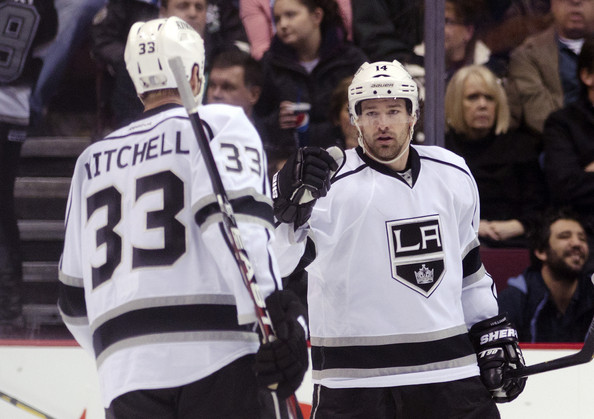
Here’s a controversial opinion, turns out Willie Mitchell might be just as valuable to a team as Ilya Kovalchuk, however since what he does isn't pretty or manifests itself in statistics it is a sacrilege to suggest this. You can expand this in general to wingers with little impact on the game when they're not scoring (there are worse examples than Kovalchuk) vs shutdown defensemen who can make a first pass and aren't boneheaded with the puck on their stick but don't put a lot of points on board. 


Since the part of the game that these type of wingers are really good at often manifests itself in either pretty dangles and points it is human nature to assume they have a bigger impact on the game as whole than they really do. A successful dangle or a quick look at statistics is very easy to notice, dangling when you have a better option open or not using your linemates as well as you could, not engaging or losing puck battles, poor positioning or lazy backchecking are often very subtle and forgiveable in human eyes when you just went through 2 guys (even if the end result is a turnover, a poor or a blocked shot or something else). This often leads to inflated contracts for these type of forwards. 

The defensive defenseman is basically the opposite of this. The part of the game they are good at doesn't really manifests itself well in statistics nor is the game they play pretty to watch or marvel at the technical skills like stickhandling, obscene shots etc.. I believe in general their contracts represent their value more accurately (though I wouldn't lose any sleep if a guy like Mitchell made 5 million instead of 3.5 which is probably below his actual value), however I think there is still some room for improvement in establishing who the best defensive D-men are when comparing them between eachother. 

It's pretty easy to say a statement like - this guy is a 30 goal scorer and justify 6 million per year without having to worry about being crucified despite the lack of his overall game (even if he bombs later), but there is nothing to hide behind when you're shelling out the money for a defensive-defenseman, it's only your opinion as to what he contributes to a team, no stats (although there has been progress in the advanced stats community) to base the value on, I do believe the GMs are much more conservative in handing out the money to the defensive D-men for this reason compared to goal scoring wingers.. For that reason I think defensive-defensemen on average receive contracts closer to their value than the goal-scoring type of wingers mentioned above do (Heatley, Kovalchuk, Semin, Kessel etc. well the Kessel contract isn't that bad).